


If you’ve ever listened back to a musical performance recorded over a video call and thought, “That’s not what it sounded like,” you’re not imagining things.
Over the past few years, mainstream video platforms like FaceTime and Zoom have quietly but aggressively optimized their audio systems for one primary goal: clear spoken voice. That’s great for meetings. It’s terrible for music.
And for musicians, educators, and adjudicators, this shift has created a serious problem.
The hidden issue: speech-first audio processing
Modern video call software is no longer a neutral audio pipeline. Instead, it uses machine learning to actively reshape sound in real time. These systems are designed to:
- Suppress “background” noise
- Remove room ambience and reverb
- Prioritize speech frequencies
- Gate sustained or non-vocal sounds
- Flatten dynamics for consistent volume
From the platform’s perspective, this is a win. From a musical perspective, it’s a disaster.
Sustained notes get clipped. Tone changes mid-phrase. Dynamics disappear. Instruments are misidentified as noise. Subtle articulation — the very things musicians train for — are filtered out.
These platforms aren’t broken. They’re simply not built for music.
Why this matters more than ever
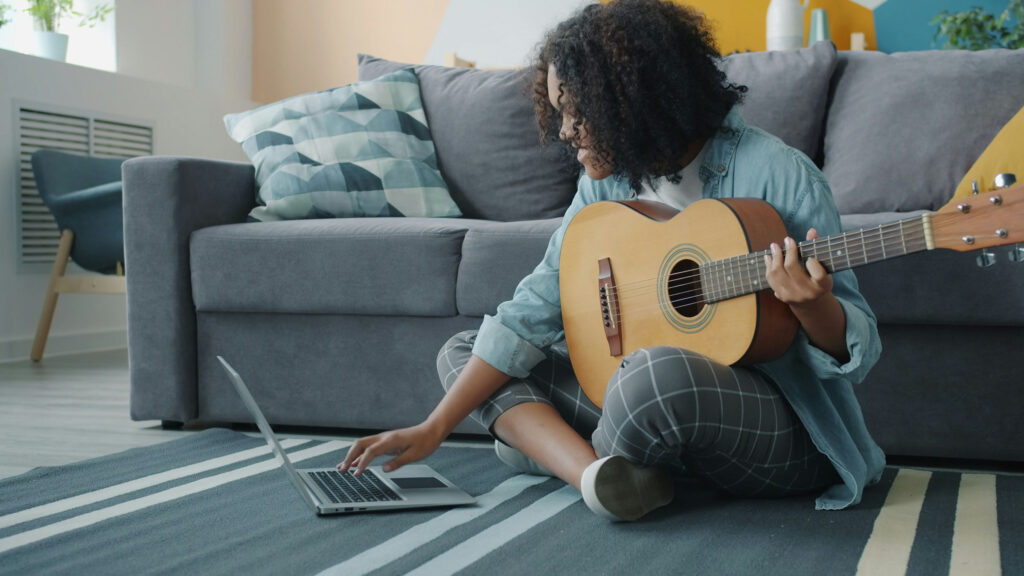
Remote music instruction, auditions, and evaluations are no longer edge cases. They’re normal. Teachers rely on recordings to assess progress. Students submit performances for auditions and competitions. Judges evaluate players they may never meet in person.
When the technology alters the performance itself, the result isn’t just inconvenient — it’s unfair.
If two students record on different platforms, or even different settings within the same app, the audio processing alone can change how their performances are perceived.
That’s a huge problem for anyone who cares about accuracy.
Enter Take Stage: built for music, not meetings
Take Stage exists because musicians need something fundamentally different.
Instead of treating music as noise, Take Stage is designed to preserve it.
With Take Stage:
- Musical dynamics are retained
- Sustained tones are not gated or chopped
- Instruments aren’t “corrected” out of existence
- Recordings remain consistent and reviewable
- Performances sound like performances
The goal isn’t to make you sound “cleaner.”
The goal is to make you sound accurate.
That distinction matters when teaching, learning, or evaluating music.
A better tool for teachers, students, and judges
Take Stage is especially powerful for:
- Music educators who need reliable recordings to assess progress
- Students who want their true ability represented
- Judges and reviewers who require consistent evaluation standards
- Programs and competitions that value fairness and transparency
When everyone uses the same music-focused platform, the technology stops influencing the outcome — and the performance speaks for itself.
The bigger picture
As mainstream platforms continue optimizing for speech, musicians are being quietly pushed out. That creates frustration — but it also creates opportunity.
Take Stage isn’t trying to compete with video call apps. It’s solving a problem they’ve intentionally left behind.
If your work depends on tone, dynamics, and musical nuance, you need a tool designed for music — not meetings.
That’s the space Take Stage proudly fills.
Leave a Reply